Squaw Valley Community of Writers

An annual event for almost half a century, this weeklong gathering of writers is one of the best and most distinctive.  Shunning the elitism that mars others with their clear demarcation of supplicants from gurus and gatekeepers, Squaw Valley mixes and mingles “staff” (everyone who comes to provide insight and guidance) and participants in one big melting pot of about 130 people, most of whom are fiction writers but with an appreciable number of non-fiction/memoir writers too.

I was invited to participate this year based on a sample drawn from a novel I’m writing. Every morning for a solid week I joined 11 other participants and a workshop leader, who rotated every day and included four well-known authors, an agent and an editor to discuss two of the groups’ 5000 word submissions for 60-90 minutes each. Every story had considerable strength; the discussions focused on possible ways to make each work better.  It was a take it or leave it, say what you feel, format with authors listening, not commenting, until the end of the discussion when we learned how close our responses and thoughts were to the goals of the author.

The rest of the day consisted of panels and readings that ran from 1pm until 9 or later at night with an outdoor communal dinner for all thown in where you might sit next to another beginning novelist or Amy Tan, a new memoir writer or Alice Munro’s editor, Ann Close. The panels also involved writers, agents and editors, all of whom were familiar names and faces and they all had great things to say on everything from whether every novel is a mystery novel to how to write about sex. It felt as if I were strolling along inside the mind of a collective genius, especially as someone making the difficult transition from academic to creative writing.

Anyone in love with words, as, I confess, I am, would find themselves in heaven. Discussions of point of view, voice, the uses of past and present tense, reliable and unreliable narrators, rhetorical figures, narrative structure and stylistic effect–in workshops, panels, over coffee, at dinner and in the bars–were the staples of the week. And gradually, as the days passed, a true sense of community grew and grew. Before going, I told people I was going to a writer’s conference or workshop but not to the Community of Writers. It seemed too corny. But after having attended, and feeliing now a part of that group, I will ONLY say that I was part of the Squaw Valley Community of Writers in 2015.

You can find more about the Community on its Facebook page.

Steve Jobs: The Man in the Machine

Alex Gibney’s on a tear. He’s one of the few documentary filmmakers who is releasing more films than most folks can keep up with, including Mr. Dynamite: The Rise of James Brown; We Steal Secrets, on Julian Assange; Sinatra; Going Clear, on Scientology, and The Armstrong Lie. Steve Jobs: The Man in the Machine, which Gibney narrates, seeks to answer a simple question: why was a man who was as much a terror as a genius, as much a heartless cad as a savior, as much a ruthless busnessman as a tech guru mourned by millions who never met him?
The film follows what is a familiar Gibney tack, dating back to Enron: The Smartest Guys in the Room: successful men are given their due but their feet of clay are thoroughly exposed as well. Hubris radiates from their very being, or as Job’s first long term partner and mother of his first child, Lisa, notes, he was one of those rare individuals who achieves enlightment through his ego rather than despite or beyond it. He never exhibited empathy toward others, and even tried, in slanderous fashion, to deny the paternity of his first child, until DNA evidence made his lies impossible to sustain. (There is an echo here of Lance Armstrong’s vehement denials of drug use until the test evidence became too overwhelming to deny but it is just one of many lies Jobs spins in the course of the film.)
But, we say, all is forgiven: Steve Jobs singlehandedly gave us the iPod, iPad and, most radiantly of all, the iPhone! His product announcements were major media events and he was, without doubt, The Man in the machine, expressing the wonder and awe we all feel at the magic that digital technology can work.
So why the vast wave of mourning?
Gibney doesn’t answer the question so much as use it as a pretext to explore Jobs’ contradictions, the thing he also does with Elliot Spitzer, Lance Armstrong, the Enron guys, scientology and Julian Assange. He is our best documentarian when it comes to setting black and white contradictions side by side so that icons and heroes remain so, but with a new found sense of their flawed, sometimes fatally flawed human nature.
And Jobs? Wasn’t he the charismatic face of an entire industry? Other names, from Melissa Mayer to Bill Gates, make the news but none have the charisma of Jobs, who was not only a highly savy geek (and what he didn’t know Steve Wozniak, co-founder of Apple and early casuality of Jobs’ callous ways, did), he was also a born salesman. He gave gadgets a human face. He made us not just want but need them.
This moves into terrain Gibney fails to explore: fetishism, commodity fetishism, to be exact. We overvalue an object because, as Marx explained and as advertisters have known ever since, we fail to see the real human labor that went into it and behold it, instead, as a magical talisman of great power or beauty that arrives from nowhere, or in the hands of a god as a wonderous offering. The fetish stands apart and possesses an aura we come to worship or at least experience with awe. And when we want to associate this with a human face–there it is: not the buxom model standing next to the latest sports car, but Steve Jobs, the man in the machine.
In that sense, the mourning for Jobs was mourning for a dead god, a figure who did not so much produce the magic as stand as its iconic face. That this face was Janus-like is not surprising. How can a commodity be both a thing of beauty and the result of mass pollution, grossly underpaid and overworked employees in foreign lands, suicides and despair? How can a thing earn our deep admiration and also be the source of egregious profit ($300 per iPhone, eg!) that, following the logic of the market place, is not even taxed because it’s tucked into overseas accounts? How can Jobs be a guru and a genius but also a man who lies, deceives and intimidates to get his way?
Is he not an emblem for the contradictions of capitalism itself, a system that uses the fetish object as a distraction from the wreckage that lies behind the marketplace? And as the only such emblem in the enire IT sector, it is little wonder that his passing was profoundly mourned. We are left with the image of an dark, secretive industry of anonymous but revered drones that Jobs himself helped create in the famous Super Bowl ad of the 1984 world we will never need to experience as long as there is a cute little Apple to overthrow the authoritarian IBM’s of the world. But Jobs’s Apple became IBM and in doing so, demonstrated, when we pull back the veil his company has done so much to maintain, the contradictions of a system he never even attempted to alter even as he added a potent new domain to its rule. In that sense, Jobs was more machine than man, but that is what fetishism urges us not to see.

Oscars: Lost, Lost, Lost

What’s become of Oscar? It all began as a way to buy off discontent by handing out awards for good filmmaking, and behavior, in the 1920s when union activism, to some extent Communist led, threatened the autocratic iron hand of the studio bosses. Now it’s little more than smoke and mirrors, a parody of its own co-optive origins. The super-baroque set this year set a new low in garish overkill, with enough Oscar statuettes, most of them Robocop size, to suggest a deep rooted sense of panic and insecurity about the significance of this unsexed little sourvenir and all the fuss over it.
The Academy hived many technical awards off to a separate event some time ago and needs to do the same with most of the below the line awards for costume design, sound editing, and so on. Over an hour went to awards that no one remembers and few care about, despite their genuine value to film production.
The songs, designed to support dramatic films, are usually too insipid to stand on their own and to convert them into cornerstones of kitschy spectacle becomes a pathetic case of desperation. The glitzed p production numbers can’t compare to MTV videos or even to the Super Bowl at half time; they’re knock offs, highlighting songs meant to lend emotional support to a film, not steal the show. Would anyone deeply miss them? Why not have musicians who performed in nominated films do a different number, one where they can show their stuff, and Please, Please, no more Sound of Music-like resurrections of the long dead!
How about a host who’s just an MC rather than a more often than not failed prime mover whose jokes are pathetic, if not distasteful, and whose sense of genuine respect and appreciation for the achievements of others seldom on display? How about Colbert or Daily Show-like sketches that poke some real fun at all this pretense? How about some behind the scenes, candid footage of the actors, actresses and directors who are the heart and soul of the awards rather than clip after clip of films many viewers have aready seen? Where does Clint go to workout? Does he have a spotter for bench presses and what flavor smoothy does he drink after? How does Julianne Moore interact with her kids? Does she drive them to school? What do they talk about? What’s J.K. Simmons like when he’s listening to music or heaading to the beach? What does Inarritu think of Kim Kardashian or Tatum Channing? How did Steve Carrell transform himself into “coach” or “Eagle” for his role in Foxcatcher? What did he do after wrapping for a day? Would’nt little clips like those give us something a lot more fun to see than clips from movies that are no better than the trailers we’ve seen a dozen times before?
And there’s always the fasion show side to it, something in the midst of sliding from runway try outs to Why are you staring at me? I’m an actress not a pin up type resistance to the very thing wearing these extraordinary gowns invites? Let’s see the women really go to town on the feeding frenzy voyeurism and turn up in jeans, designer jeans of course, accessorized by Jean Paul Gaultier in his max leather mode. And tell it like it is: You may think I am trying to draw attention to myself and my fabulous looks but I’m really here as an artist to celebrate great achievements in motion picture making, just like everyone else, so let’s go on with humdrum lives and hand out some Oscars.

Alcatraz and Ai Weiwei: The Scene of the Crime

You get the idea that this is a bad place right away.

Alcatraz with Angel Island in the background.

Alcatraz with Angel Island in the background.


Discarded, but a black and white reminder of just how stark this place can be.

Discarded, but a black and white reminder of just how stark this place can be.

Set like what should be a jewel in the middle of San Francisco Bay, Alcatraz, the island, is nothing but rock and Alcatraz, the prison, nothing but misery. The free audio tour, with the voices of former guards and prisoners, recreates what it would be like to an inmate and it’s not a pretty picture. Cells are tiny, places to roam or exercise or read are miniscule to non-existent.

Ai Weiwei has been to jail. In China. For alleged tax-evasion. The two documentaries about him, Ai Weiwei: Never Sorry and Ai Weiwei: The Fake Case, give a vivid sense of his art, politics, humor, decency, integrity and status as a thorn in the side of a near totalitarian government. He can’t leave the country but this exhibit exploits that fact. He has created an installation of multiple works that remind us how international and relentless the pressure on political dissent is. From the colorful dragon that snakes through half of the building where prisoners were allowed to work to the Lego-based images of scores and scores of political prisoners around the world, Weiwei draws us into a world we would rather forget and reminds of just how high a price dissent, protest and militant activism often entails.

The dragon's head wlecomes us to the former prisoners' "work" area.

The dragon’s head wlecomes us to the former prisoners’ “work” area.

A reminder of  the thin line between in and out, free and captive, liberty and oppression.

A reminder of the thin line between in and out, free and captive, liberty and oppression.

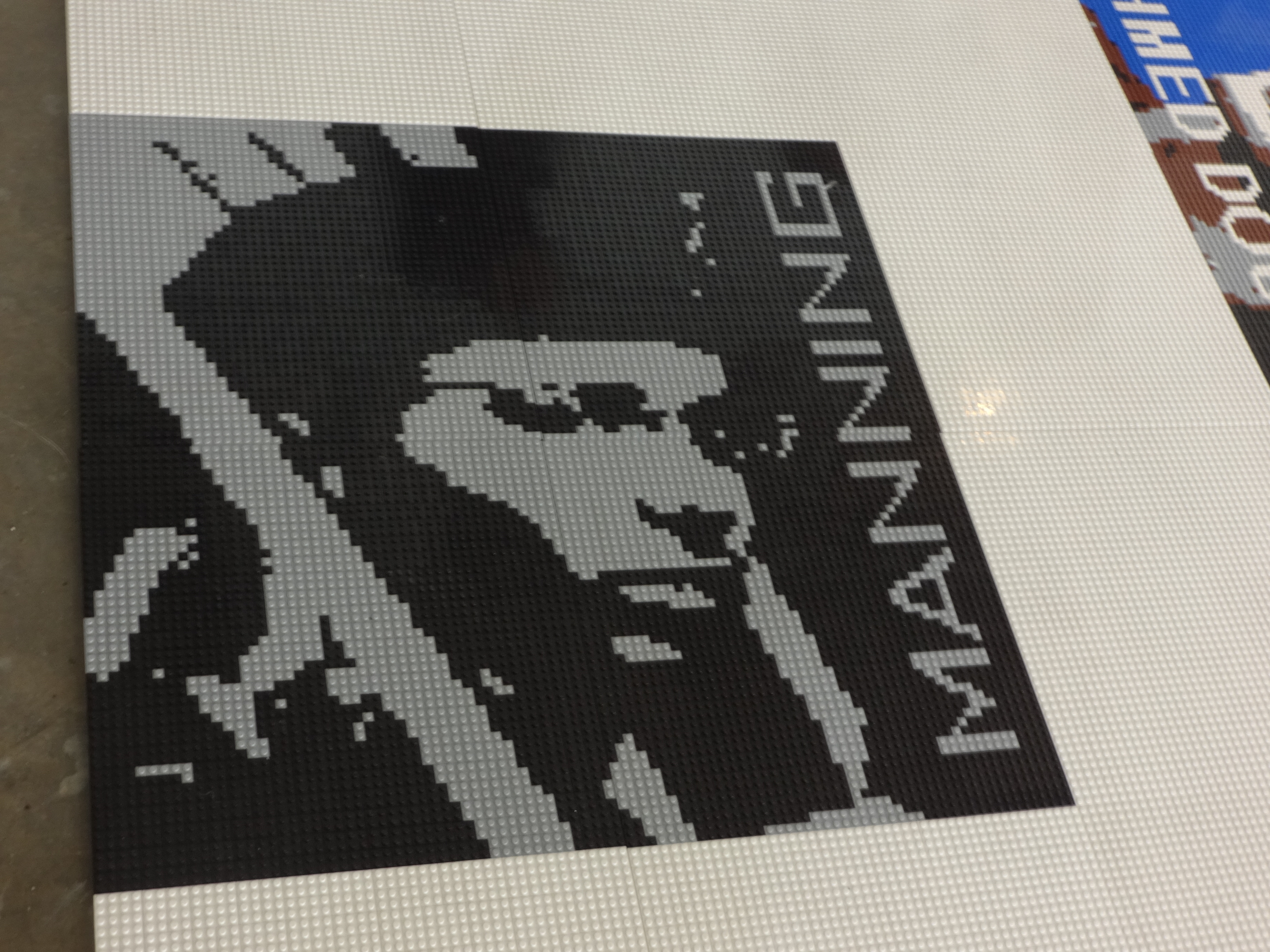
The Lego images are of far more people than most of us have heard of; Weiwei has culled them from around the world. The small pieces of interlocking tessera reassemble people whose lives have been torn apart, whose existence has been minimized and whose identities have been demonized. Some are prisoners no longer such as Nelson Mandela, while others, like Chelsea Manning and Edward Snowden occupy liminal spaces within or beyond prison walls. Weiwei gives them a vivid, fractured presence that we must actively reassemble and integrate in our own minds as we wander in this desolate workspace, a void in the spirit world of life.

One of the large arrays of images in the work space. There are five such arrays in all.

One of the large arrays of images in the work space. There are five such arrays in all.


Chelsea as she might be seen today were she not in prison for helping expose the secret acts of our government's war on civil liberties and privacy in the name of a war that seems to perpetuate the very thing it seeks to eliminate: terrorism.

Chelsea as she might be seen today were she not in prison for helping expose the secret acts of our government’s war on civil liberties and privacy in the name of a war that seems to perpetuate the very thing it seeks to eliminate: terrorism.

Alcatraz: Nowhere To Go

Alcatraz: Nowhere To Go

Life itself and Roger Ebert

Life Itself hits you hard. Although it has elements of a biography and covers Roger’s overall (and quite impressive) career that led him from being an extremely talented newspaper guy even before he got to college, the gut-wrenching part is his battle with cancer. We first see him in the hospital where his near perpetual smile seems utterly at odds with the devastation wrought by cancer. Without a jaw or a voice, Roger carries on, blogging, smiling, joking and being cared for by his wife, Chaz, a pillar of compassion.
Steve James, who made the film with Roger’s considerable cooperation, was a director of Hoop Dreams, one of the great longitudinal films about youth coming of age, centering on two aspiring high schoolers with dreams of professional basketball careers. Their dreams didn’t quite work out but they grew and matured all the same. Roger’s dream did come true. He became the outstanding journalist he always dreamed of becoming, as a film critic it turns out, when his early bent seemed in politics and sports. But he was an adept writer, graceful, to the point, and never demeaning to films or their makers. The latter is a rare quality. Some critics, like, to name one, Anthony Lane, at The New Yorker, seem to pride themselves on acting superior to the films they have to review, judging by the frequency with which they display their wit at the expense of the films they discuss. Roger did not like all films by any stretch–a touching moment is to hear his give a thumbs down to The Color of Money after becoming a good friend of Martin Scorsese, but not with cheap jabs at Scorsese or the film–but when he disliked a film he remained as passionately detached from personal attack or snide wisecracks as he was committed to the films he loved.
His spirit was generous. I knew him more from his TV show with Gene Siskel and thought the thing a bit lightweight. It wasn’t until later that I became better familiar with his written reviews and his considerable gift for getting to the essence of a given film, for better or worse.
Life Itself reminds us of what a career well made means to those who share it, of what a marriage relationship and family life can be at their best, and of what a life well lived feels like to those who can now, thanks to this film, behold it. Roger didn’t just exemplify the best of movie criticism, he exemplified what it’s like to live, and die, with grace and dignity.

Documentary Nomads

A fascinating program for documentary filmmakers has emerged in Europe. Called DocNomads it involves stays in three cities over the course of a year: Lisbon, Budapest and Brussels. Students work with resident instructors and master class guests in each location and make films in each city, and sometimes in the countryside as well. The students come from all over Europe and beyond. In Budapest Tamas Almasi heads the program and I recently visited there to offer a week long master class on selected issues and concepts in documentary. I had students from Ecuador, Belarus, Serbia, England, France, Italy, Russia, Hungary, the United States, and ten other countries, if not more. They come with filmmaking skills and an undergrad degree behind them and are ready for the new challenges the course offers. Language is one of them. The course is offered in English but in every location most of the students do not speak the local language. This makes their production work challenging but far from impossible. They are a resourceful, inventive group, among the best I’ve worked with, and the program is a brillaint model for how to think outside the somewhat zenophilic boundaries of much documentary production.

It’s a program that deserves emulation.

The Oscar Boys of 2013

Cate Blanchett is a strong choice for Best Actress, but the Best Actor category is full of strong contenders who all deserve to win. But one stands out.
Bruce Dern: very solid as the cranky old man in Nebraska. He captures the idiosyncracies of someone who never was the brightest light in the room or the life of the party but still commands the love of his son and a mix of emotions from others. His quirkiness and selective memory keeps the picture from going off the rails into the nostalgic or maudlin but the picture leans heavily that way. Not one of Payne’s best efforts. The ironies are far less rich than in Election, Citizen Ruth or Sideways. Dern deserves praise but probably not an Oscar.
Christian Bale: a terrific job as the off-balance scamster in American Hustler. As we might expect, it’s hard to know when he’s scamming himself as well as others and his shrewd playing of others against each other is brilliant. Still, it’s probably not quite as brilliant as the actor I’m leaning toward.
Chiwetel Ejiofor: great role, great performance in a fine, wrenching film. Ejiofor does not play the over the top Avenger or the simmering-inside Rebel, but a dignified man who finds himself in a world where dignity is denied, relentlessly. His expressions of suppressed astonishment and frustrated yearnings makes the movie a true stand out. Would that it were on the global sex traffic in women, teens mainly, that is with us now, but long ago is a bit safer and more nobel as a statement about injustice and abuse. That slight edge of safety may be enough to tilt the Oscar into other hands.
Leonardo diCaprio: here we go again. Marty Scorsese on a delerious whirlwind tour of male misogyny, depravity and greed. DiCaprio captures it brilliantly but he also lights up, like a giant billboard, the repetitious nature of Scorsese’s obsessions. Goodfellas and Casino covered this perfectly and now we have a selfish, heedless huckster who takes Wall Street by storm, makes his millions and learns nothing. A film more about addiction than greed, though that is clearly one addiction, DiCaprio is caught in a paint by numnbers tale that demands little growth or change in his character. In fact, he seems like an addict who never hits bottom and that one-note quality will probably be enough to send the Oscar elsewhere.
Matthew McConaughey: An amazing job as the womnanizing, drug-addled rodeo hanger-on who sees the light and becomes a beacon for HIV infected others, like himself. Like Bale, McConaughey sacrifices his body for the role, losing a huge amount of weight but, more than Bale, pulls out all the stops on a ride to heaven, and hell. His range is breath-taking and we are not hampered by the need to scam the viewer as well as other characters that leaves key parts of the Bale character shrouded in mystery. Like Jared Leto, my choice for Best Supporting Actor, McConaughey takes huge risks and they all pay off. He demonstrates what great acting in a powerful film is all about.
He’s my choice for Oscar, but not necessarily the Academy’s. On that: Ejiofor is strong choice for liberal sentiment, DeCaprio for career sentiment, Dern for hanging in there sentiment, and Bale, for playing the guy everyone in Hollywood’s seen over and over–the scam artist. McConaughey is then a bit of long shot for sheer brilliance in acting. My guess is the Academy will go for Ejiofor and it’s clear all five of these guys deserve it. How about an arm or a leg each?
Final Note: Christian Bale and Matthew McConaughey show what great actors can do in terms of adapting themselves to challenging roles. They have become what many thought, including me, Johnny Depp would become: an actor of amazing range and depth willing to do whatever it takes to bring a role alive. Depp has drifted into playing parodies of that idea but Bale and McConaughey show us what risk and reward are all about and on a grand scale. This point is not uniquely mine: the Huff Post had an article contrasting Depp’s descent with McConaughey’s rise on 1/3/14 but I just found it today. That, though, makes two of us wishing McConaughey further success and hoping Depp can pull himself out of the dreck.

Obama’s Fatal Error

Let’s go back to the beginning of it all, 2008, when a newly elected President Obama arrrived on a promise of change and the nation had seen enough lying, deception and outright criminality by leaders who rewrote what words like “torture” meant to suit their ends. A fraudulent, completely unnecessary war gave Al Qaeda a new recruiting ground (it didn’t exist in Iraq before the U.S. invasion) and a poorly executed, half-baked effort to capture Osama Bin Laden in Afghanistan floundered and morphed into another hopeless attempt to win hearts and minds by having soldiers storm through villages and prop up a corrupt regime.

But it all did yield profits for the defense industry and lots of prisoners who got shuffled off into black sites and Guantanamo where torture was the name of the game.

What if Obama did then what many urged? What if he ordered a formal investigation into whether crimes against humanity had occurred during the Bush administration? No one would expect Bush, Cheney, Rumsfeld, Rice, Gonzales and the other decision makers to serve jail time or perhaps even to stand trial but if there had been a finding that Yes, indeed: crimes against humanity occurred and these were the ones responsible, a new, clear, honorable moral tone would have begun to take hold. And even if the charges led to a trial, President Obama could use, properly, his right to pardon as a way to avoid what could become a political football and an international embarrassment. The shame could be left at the feet of the perpetrators.

Such action would have confirmed President Obama’s desire for change, his determination to set a new course, his vision of a future that remained true to the great American values of due process and the rule of law.

Instead Obama has slowly and it seems inexorably drifted into complicity with what we thought he’d change: prolonged, grinding wars in Afghanistan and Iraq for far longer than necessary to dismantle the core elements of Al Qaeda housed there; continued coddling of the corrupt regime in Pakistan that clearly and well nigh openly shielded Bin Laden and droves of other terrorists; efforts to compromise with those Senator Reid has finally identified, correctly, as “Banana Republicans”–extremists who seek to overthrow the Constitutional division of powers and nullify existing law by refusing to respect either their opponents, the Constitution or the vast numbers of us who need, want and value government services from the National Parks and air controllers to the FDA and Medicare; continued and expand the use of drone aircraft attacks against presumed terrorists despite vivid evidence of killing civilians as well; continued to rely on Depleted Uranium as a key element of shells even though these shells virtually vaporize, creating micro-particles that indiscriminately ravage the lungs and distort the DNA of those nearby, including U.S. troops, and despite a hypocritical aversion to chemical weapons if used by adversaries; hanging onto the economic advisors who sat on their butts as we slid into a totally avoidable economic crisis (who, in Larry Summers and others, in fact helped engineer it by promoting the legislation that allowed for the reckless practices that led to the overinflated balloons of bad, very bad, debt, that burst; giving in on aspects of the initial Affordable Health Care Act in order to placate the radical right but with painful consequences for the millions of us who were counting on the government to modernize the 1930s legislation that began to weave an indispensable safety net under the bloody arena of the so-called free market.

Taking the moral high road from the very start would have made all this folly stand out for the folly it is because it would have been clearly and cleanly repudiated.

We’d be in a very different place today and those who got us here would know full well that we know who’s responsible for attempting to plunge this country into the dark world of terrorism, greed and mindless conduct that has, instead, become all too rampant and all too familiar.

Anna Wintour and Anorexia

The New York Times recently noted that Ms. Wintour serves as a roving editor at Conde Nast, not only editing Vogue but overseeing the fate of the half dozen other women’s magazines that Conde Nast publishes.
She is a perfect position to stand up against the relentless, unbending dominanace of the anorexic as an aesthetic ideal. It is clearly valuable as an easy way to make clothing drape and hang elegantly, as it might on a clothes hangar, but it comes at a huge cost, not only to the women who starve themselves for the sake of their fleeting careers as models but to all those other women who internalize a near impossible, estremely unhealthy ideal. It is clearly not a gold standard that persists across cultures and centuries but its grip on the modern fashion industry is long overdue for change.
Despite the confessional books that chronicle its devastating effects on individuals, despite the outcries from parents and feminists, despite the alternative models and standards that can serve fashion well, anorexic models remain the default option of almost every fashion label on the planet. Anna Wintour is one of the few individuals who could actually make a difference. Why doesn’t she just do it? Millions of women, and concerned men as well, could stand behind her.

Visible Evidence at 20

Twenty years ago (1993) a few schoalars, notably Michael Renov and Jane Gaines, conceived of a conference devoted to documentary film.  It was two years after my book on documentary, Representing Reality, opened up this field to more than content analysis and the event was a small but great success.

It could easily have been over and out at that point.

But the ball started rolling and for the last 20 years an annual conference has taken place, everywhere from Canberra, Australia to Istanbul, Turkey.

This year’s event, in Stockholm, was spectacularly good. Malin Wahlberg and her team created a near ideal conference.  A rich array of topics came up for consideration from shame in reality television shows to the impact of audiences of reenacted mass murder (in the astonding film, The Act of Killing). People, some people, still read their papers as if they were reciting the alphabet (presenting their thoughts, as orators learn to do, is a skill many academics never learn), but not all did so by any means and what gave great vitality to the conference was the adroit mix of events. Parallel panels, up to five at once, were one thing, but sandwiched between them were 30 minute coffee breaks that allowed for genuine minging and interaction.  (That panels and other events stared punctually, made everything work even better; over the four days of the conference, I only attended one panel that started quite late; that lapse seriously harmed the panel’s format but it was a rare and perhaps unique lapse.) And panels were definitely not the only attraction in this multi-ring circus.  Screenings of films also paralleled the panels or took center stage during parts of the day or at night.  At other times, keynote speakers offered papers to the entire assemblage and lunches were available in the same building as everything else: Filmhuset, the national film center that is associated with Stockholm University, the national film archive and more. An exception was a buffet dinner/reception at the colossal, gold-leaf covered City Hall, where finely attired waiters brought out a tasty array of Swedish dishes and poured some excellent wines to mark the 20th anniversary.  The only flaw was when the same waiters gathered up the serving trays and returned them to the kitchen, to the dismay of the assembled guests, when the pre-dinner speakers carried on longer than expected, but they eventually concluded their remarks, the serving trays were brought back out and everyone enjoyed themselves on a summer night in Stockholm.

It would be hard to imagine a more well conceived conference, with a more engaged gathering of filmmakers and scholars but I hope there will be many more like it in the future.