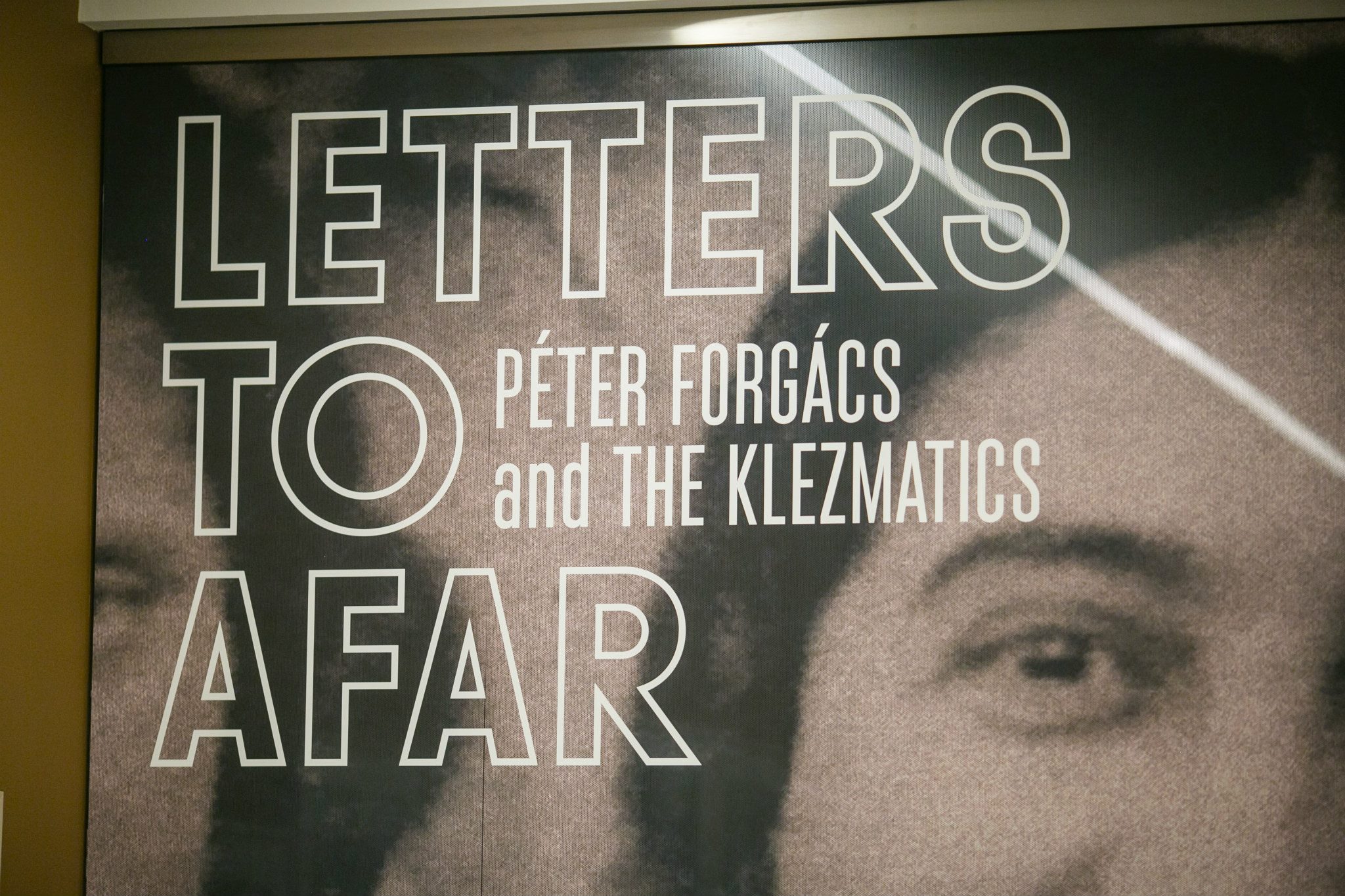
Letters to Afar: Peter Forgacs’ New Installation

The Opening

To say that this installation, at the Contemporary Jewish Museum in San Francisco, is amazing is to scratch the surface.

Made up of 13 screens, all large–some on scrims that let the image pass through 3 or 4 layers of cloth before finally fading into nothingness, sone on screens, some on the museum walls, some in horizontal diptyches, some in vertical ones, some with vocal accompaniment, some without–the images are both pedestrian and astounding. Shot by visitors to Poland in the 1920s and 30s, and intended as home movies, they are far from the usual cute pictures only of interest to the family they capture. The visitors are returning. They are Jewish-Polish immigrants who became Jewish-American success stories, men who could afford a camara and even, sometimes, a cameraman. They are returning to their places of origin and the extended families that dot the Polish landscape. From Krakow, Lodz and Warsaw to dozens of shtetls, they shot images of the life and people they have left and need to remember.

Their images create an archive of a lost world, though the archive itself persists at YIVO in New York city. Forgacs went through the vast inventory of home movies and selected about 6 hours of footage to organize into the installation. Most screens or clusters of screens feature footage from a single location: a major city or shtetl. People go about their daily lives; people look at the camera and often pose for it; people live their middle European lives in the period between wars as if it will go on forever. There is immense vitality and joie de vivre in what they do and how they represent themselves. Forgacs has skillfully given us a sense of a culture that possesses enormous strength, diversity, confidence and zest.

How could it disappear? How much diabolical work had to go into making that happen? This installation makes clear that no small effort would suffice. It would have to be a genuine catastrophe, a holocaust of unimaginable proportions. Such an event is nowhere to be seen in the installation but it lives in our memories and hearts and when those memories of what will happen next confronts this testament to what went before, the result is dumbfounding. Beauty and joy hover near the wings of a maelstrom that is soon to descend. We can only rejoice at this reclaimed world and mourn its horrific passing.

a Forgacs triptych with 3 viewers

Oscars: Lost, Lost, Lost

What’s become of Oscar? It all began as a way to buy off discontent by handing out awards for good filmmaking, and behavior, in the 1920s when union activism, to some extent Communist led, threatened the autocratic iron hand of the studio bosses. Now it’s little more than smoke and mirrors, a parody of its own co-optive origins. The super-baroque set this year set a new low in garish overkill, with enough Oscar statuettes, most of them Robocop size, to suggest a deep rooted sense of panic and insecurity about the significance of this unsexed little sourvenir and all the fuss over it.
The Academy hived many technical awards off to a separate event some time ago and needs to do the same with most of the below the line awards for costume design, sound editing, and so on. Over an hour went to awards that no one remembers and few care about, despite their genuine value to film production.
The songs, designed to support dramatic films, are usually too insipid to stand on their own and to convert them into cornerstones of kitschy spectacle becomes a pathetic case of desperation. The glitzed p production numbers can’t compare to MTV videos or even to the Super Bowl at half time; they’re knock offs, highlighting songs meant to lend emotional support to a film, not steal the show. Would anyone deeply miss them? Why not have musicians who performed in nominated films do a different number, one where they can show their stuff, and Please, Please, no more Sound of Music-like resurrections of the long dead!
How about a host who’s just an MC rather than a more often than not failed prime mover whose jokes are pathetic, if not distasteful, and whose sense of genuine respect and appreciation for the achievements of others seldom on display? How about Colbert or Daily Show-like sketches that poke some real fun at all this pretense? How about some behind the scenes, candid footage of the actors, actresses and directors who are the heart and soul of the awards rather than clip after clip of films many viewers have aready seen? Where does Clint go to workout? Does he have a spotter for bench presses and what flavor smoothy does he drink after? How does Julianne Moore interact with her kids? Does she drive them to school? What do they talk about? What’s J.K. Simmons like when he’s listening to music or heaading to the beach? What does Inarritu think of Kim Kardashian or Tatum Channing? How did Steve Carrell transform himself into “coach” or “Eagle” for his role in Foxcatcher? What did he do after wrapping for a day? Would’nt little clips like those give us something a lot more fun to see than clips from movies that are no better than the trailers we’ve seen a dozen times before?
And there’s always the fasion show side to it, something in the midst of sliding from runway try outs to Why are you staring at me? I’m an actress not a pin up type resistance to the very thing wearing these extraordinary gowns invites? Let’s see the women really go to town on the feeding frenzy voyeurism and turn up in jeans, designer jeans of course, accessorized by Jean Paul Gaultier in his max leather mode. And tell it like it is: You may think I am trying to draw attention to myself and my fabulous looks but I’m really here as an artist to celebrate great achievements in motion picture making, just like everyone else, so let’s go on with humdrum lives and hand out some Oscars.

Alcatraz and Ai Weiwei: The Scene of the Crime

You get the idea that this is a bad place right away.

Alcatraz with Angel Island in the background.

Alcatraz with Angel Island in the background.


Discarded, but a black and white reminder of just how stark this place can be.

Discarded, but a black and white reminder of just how stark this place can be.

Set like what should be a jewel in the middle of San Francisco Bay, Alcatraz, the island, is nothing but rock and Alcatraz, the prison, nothing but misery. The free audio tour, with the voices of former guards and prisoners, recreates what it would be like to an inmate and it’s not a pretty picture. Cells are tiny, places to roam or exercise or read are miniscule to non-existent.

Ai Weiwei has been to jail. In China. For alleged tax-evasion. The two documentaries about him, Ai Weiwei: Never Sorry and Ai Weiwei: The Fake Case, give a vivid sense of his art, politics, humor, decency, integrity and status as a thorn in the side of a near totalitarian government. He can’t leave the country but this exhibit exploits that fact. He has created an installation of multiple works that remind us how international and relentless the pressure on political dissent is. From the colorful dragon that snakes through half of the building where prisoners were allowed to work to the Lego-based images of scores and scores of political prisoners around the world, Weiwei draws us into a world we would rather forget and reminds of just how high a price dissent, protest and militant activism often entails.

The dragon's head wlecomes us to the former prisoners' "work" area.

The dragon’s head wlecomes us to the former prisoners’ “work” area.

A reminder of  the thin line between in and out, free and captive, liberty and oppression.

A reminder of the thin line between in and out, free and captive, liberty and oppression.

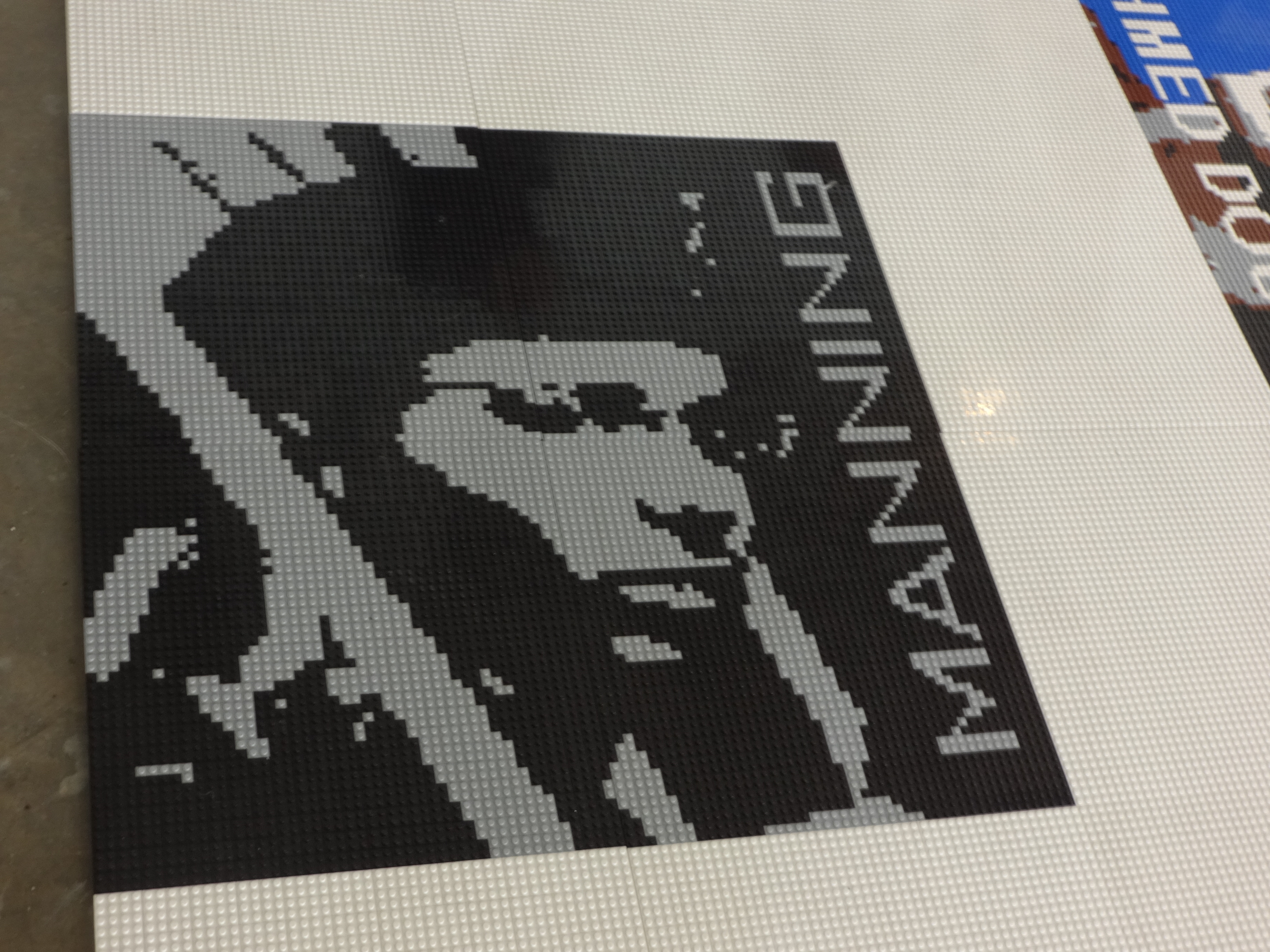
The Lego images are of far more people than most of us have heard of; Weiwei has culled them from around the world. The small pieces of interlocking tessera reassemble people whose lives have been torn apart, whose existence has been minimized and whose identities have been demonized. Some are prisoners no longer such as Nelson Mandela, while others, like Chelsea Manning and Edward Snowden occupy liminal spaces within or beyond prison walls. Weiwei gives them a vivid, fractured presence that we must actively reassemble and integrate in our own minds as we wander in this desolate workspace, a void in the spirit world of life.

One of the large arrays of images in the work space. There are five such arrays in all.

One of the large arrays of images in the work space. There are five such arrays in all.


Chelsea as she might be seen today were she not in prison for helping expose the secret acts of our government's war on civil liberties and privacy in the name of a war that seems to perpetuate the very thing it seeks to eliminate: terrorism.

Chelsea as she might be seen today were she not in prison for helping expose the secret acts of our government’s war on civil liberties and privacy in the name of a war that seems to perpetuate the very thing it seeks to eliminate: terrorism.

Alcatraz: Nowhere To Go

Alcatraz: Nowhere To Go

A Girl Walks Home Alone at Night

Ana Lily Amirpour has gotten rid of the kitschy quality of her earlier music video “Tehrangeles,” and shifted into the somewhat but not entirely campy universe of Jodorovsky, Lynch, Waters and other great explorers of the highly unlikely, extremely unnatural and totally engaging. Bad City, where “a girl” prowls the ink blot streets at night, deciding fates and seeking something she seems unable to name, stands for Tehran and Los Angeles both, it seems, and serves them equally well. No higher authorities, no police, no social justice intrudes on this world of petty crime, addiction, longing and loneliness. No social order of any distinction prevails. The handful of souls not yet consigned to the true underworld pass their days in desperate and predatory relationships that circle around overlapping needs they can act out but not identify. A desolate gully lies strewn with bodies, detritus from our vampire’s forays it would appear, though no one notices and no one cares about these festering souls at all.
Arash attends his needy, whining, drug addled dad, bails him out of money problems but creates his own, only to have the girl resolve them for him, with a bite from the apple, drug dealer Saeed’s adam’s apple, that is. Their paths run parallel for quite a while as she acts like a campier version of the Man with No Nmae or the Pale Rider, meting out an imperfect justice and longing for something never artciulated that becomes embodied in that moment when she and Arash finally encounter each other. An exquisite scene of the two of them, in one long take, holding, hugging, gazing and loving in her apartment as a pop song plays on her turn table (is it a relic or are we in the 1950s?: Arash’s classic and beloved Ford convertible reinforces the puzzle without resolving it). The girl is clearly a doppleganger in some sense, the darkness within one might say, melodramatically, and that sense gains vivid visualization in her mimicking the walk and gestures of those she encounters on the street. It deepens when she and Arash, dressed up as Dracula for a party, first meet, and crystalizes when he realizes, seeing the cat he captured and cared for now in her apartment after the violent death by teeth bite of his father, that she has done what half of him wished for: freedom from the father who no longer is one.
Amirpour clearly has seen a lot of films and is deeply immersed in popular culture; the mix provides the thrill of it all for some yet can also distract others from the tautness of the narrative obsessions and the elegance of their visual expression. What arrives next from Ms. Amirpour can’t be predicted though I strongly suspect it will be more surprise than repetition.

Keith Haring at the de Young

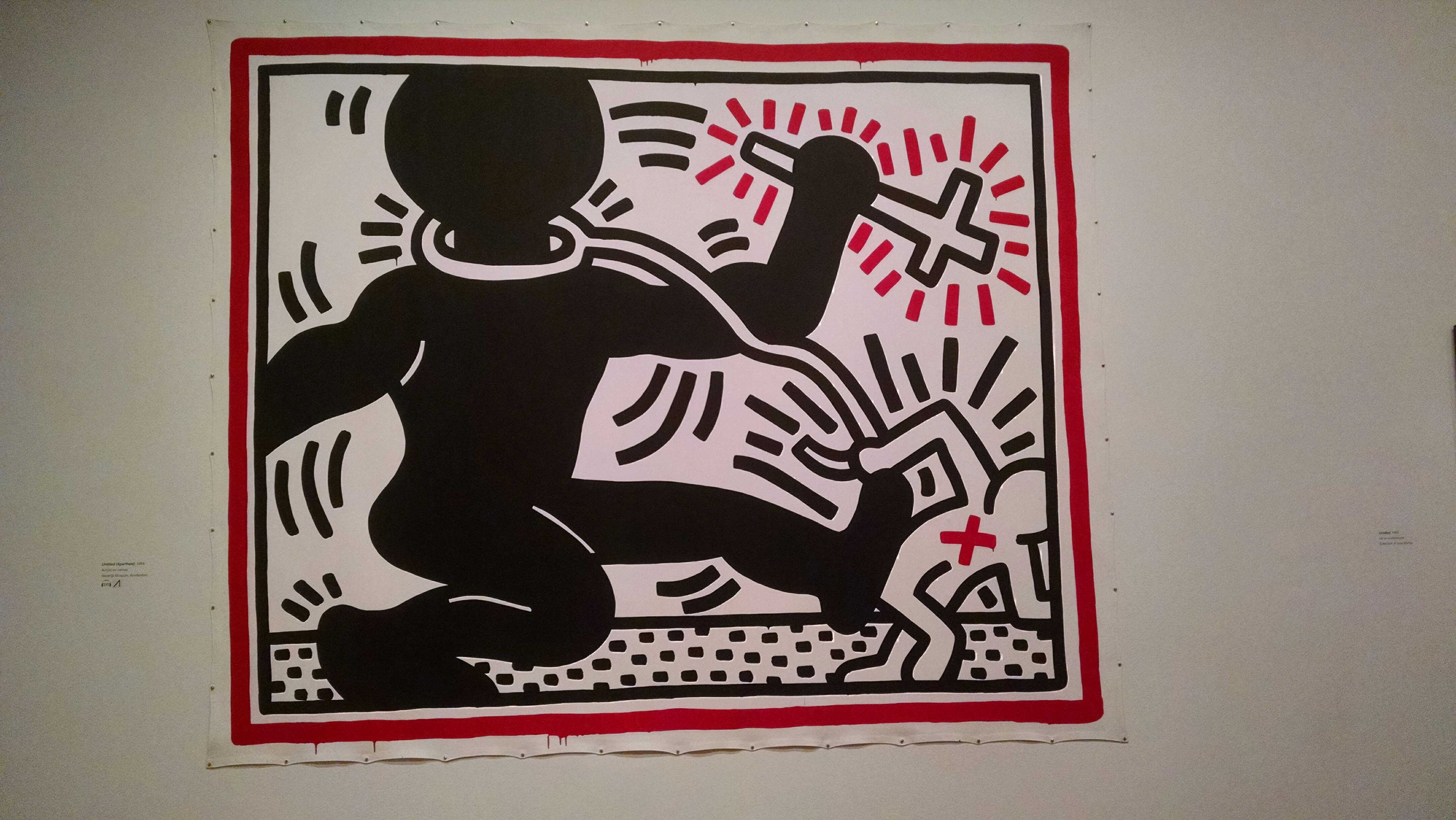
The de Young museum has a powerful collection of Keith Haring’s more political work. His familiar style can sometimes mislead one into thinking it’s a “one look fits all” type of work but these images grab the viewer by the lapels more often than not.

One of the best known of Haring's political images

One of the best known of Haring’s political images

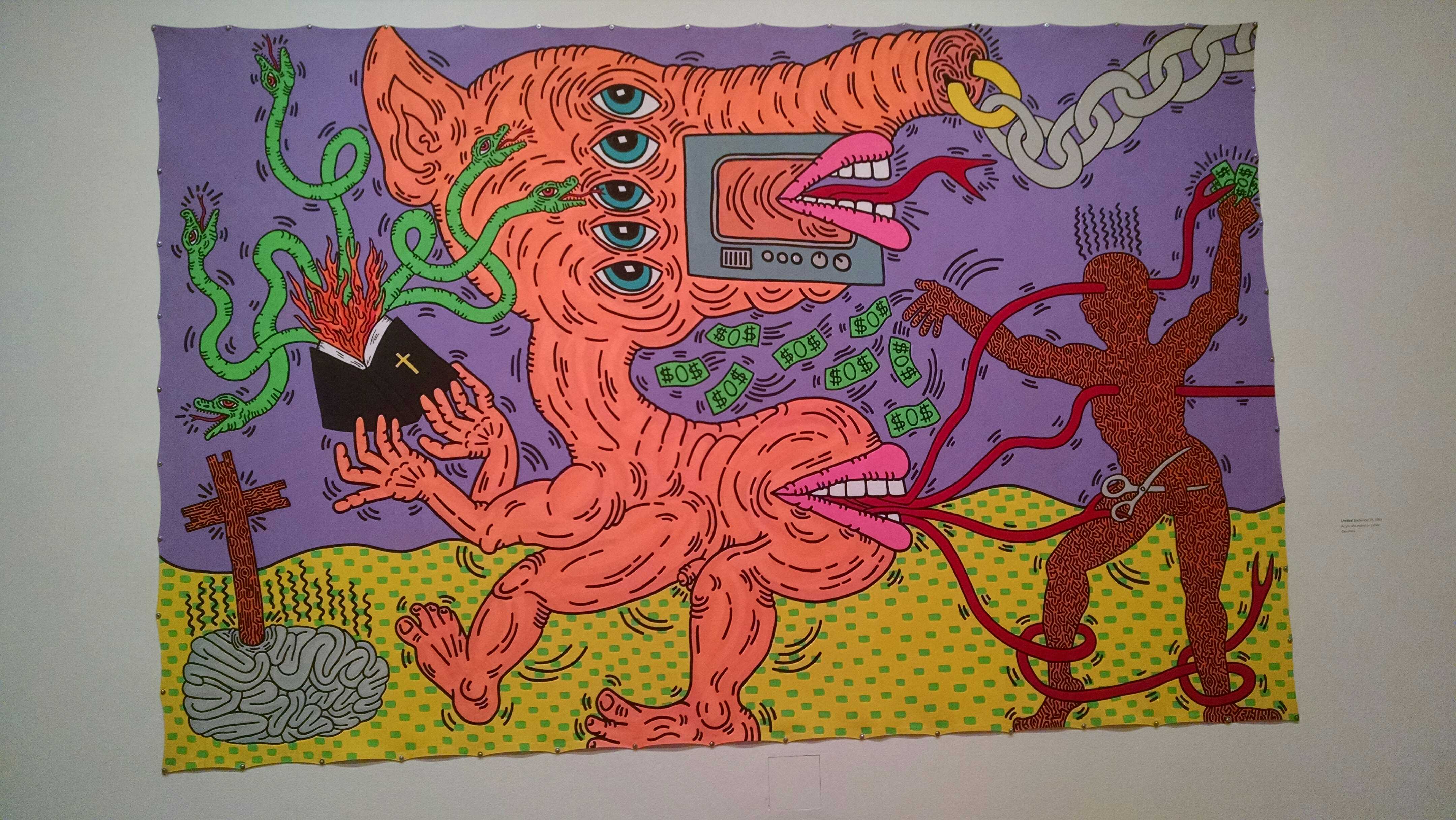
Striking is their scale and simplicity. Often made on tarpolins with store bought paint, and many dashed onto vacant advertising panels on New York subway trains, the images are stark and mesmerizing. Like the Aboriginal dream paintings that his repetitive use of symbols and icons resemble, the images transport us to a dream, or nightmare, world where ordinary humans are sujected to endless tortures, dismemberments and death at the hands of large, looming figures that are animalistic or machine-like more often than not.

The TV monster and the helpless man. The injunction to Kill your Television has come too late. Haring's figures are captives and victims of forces they may have created but no longer control.

The TV monster and the helpless man. The injunction to Kill your Television has come too late. Haring’s figures are captives and victims of forces they may have created but no longer control.

It can be easy to think of Haring as an “easy” artist: easy on the eyes, easy on the mind, easy, sometimes, on the pocketbook with his accessories, knockoffs and mass produced items, but a political motif runs vividly through this show, if not his oeuvre. He clearly finds little solace in the Great Society or the war in Vietnam, or Reagonomics or the continuing, and still continuing, racism, exploitation and media circus that surrounds him and that he both cultivated and subverted.

Elsewhere he associated the crown with Basquiat and here it seems to crown the central figure who leaps between a bleeding heart and headless body.

Elsewhere he associated the crown with Basquiat and here it seems to crown the central figure who leaps between a bleeding heart and headless body.

The museum gift shop is chock full of Haring-abelia for the acquisition minded, but the real gift is in the work itself. It haunts and moves and provokes and reminds us that there is a dignity in the gesture of resistance, of a great refusal of that which is everywhere celebrated and normalized… until it isn’t.

Some images are dense with iconic doodles and some have the starkness of a Philip Guston anti-KKK painting or Guernica. This is one of them.

Some images are dense with iconic doodles and some have the starkness of a Philip Guston anti-KKK painting or Guernica. This is one of them.

IDFA 2014

IDFA is the International Documentary Film Festival in Amsterdam that is probably the biggest and most important doc fest of the year with over 300 films, a market of films for sale, web based docs on view and many side events.
This year was distinguised by a number of very intense, powerful films involving war and trauma from Joshua Oppenheimer’s follow up to The Act of Killing, The Look of Silence, about an eye doctor who confronts former death squad leaders and their families at no small amount of rish to himself, Drone, on the US drone war and a “pilot” who discusses it and the trauma he’s suffered, and Of Men and War, an amazingly personal story of Iraqi vets working out their trauma in a unique program based in Napa Valley. Their tales of horrific events they witnessed or perpetrated is about as harrowing as anything imaginable and their guilt, shame, anger and profound desire to heal is breathtakingly intense. It’s one of the most powerful films I’ve ever seen; I had a chance to do a Q&A with the director after the screening and he spoke movingly of the relationships he built with the men and of their struggles to regain their souls and honor their families. He made a previous film, De Guerre Lasses (Living Afterwords: Words of Women) about women and war in Bosnia, and this one looks at men as casualties of war. No U.S. distribution yet but watch for it. It won the Festival Award for Best Feature Length Documentary and will no doubt win more awards in the days ahead.

The Film Manifesto

I’ve written a little introduction to the film manifesto as a form that’s been with us from the days of early cinema. Individuals and groups, from the Lars van Trier to the Pope have taken the manifesto road, more or less, to champion their vision for the cinema.

This is the link to the brief introduction and that should also take you to a set of actual manifestos that are drawn from a new book that is an amazing compendium of manifestos from different times, countries, people and sexual/political orientations.

This is an onliine version of material that will also appear, in part, in the next issue of Film Quarterly. It helps inaugurate Film Quarterly’s entry into cyberspace.

http://www.filmquarterly.org/2014/09/manifestos-a-forgotten-history-2/

Boyhood: Too Good to be True?

A few years ago, when Jonathan Franzen’s new novel, Freedom, came out, it got rave reviews and I thought, “If everyone loves it, it is either far too middle of the road or far too heavily marketed.” I was wrong. It’s an amazing novel and that’s a separate post, but I learned my lesson: sometimes the vast majority of critics can be right about the same thing and Boyhood is another example.
The film amazes. I kept saying, wow, they’ve done a great job with make up and special effects, only to pinch myself and say, No, those changes are real. Does it matter? –About as much as the difference between documentary and fiction matters, which is probably less than we often think but enough to be important. Every fiction is a doc to some degree. It captures parts of the world and the life of actors at a given moment. Here the doc degree is quite great. But the maturation or aging isn’t the primary point: it’s how the characters all evolve over time and do so in something closer to real time than we have ever seen in a fiction before. We can each assess each character’s evolution, and I just want to note that Patricia Arquette’s may be the most challenging to assess. She doesn’t get the big moments with Mason (Ellar Coltrane) like Ethan Hawke, his largely absent dad does. Hawke opines about everything to this young boy becoming man, but Arquette keeps the family unit intact and above water, at the considerable expense of frequent moves, prioritizing her effort to become a professor, and surviving some very abusive men. Why is she not a fount of wisdom, however well-intentioned and misguided or self-serving (as Hawke’s often is)? Why is she the suffering, self-sacrificing but also self-advancing mom who doesn’t bond very well with her kids, and even less with her daughter than her son? Linklatter’s Delpy character in his paris trilogy always struck me as a bit strained and I feel a similar lack of deep connection here.
That said, this is a spectacular film. “Problems” with women characters–giving them the density and complexity of their male counterparts–is hardly unique to Linklatter and he does, to his great credit, not make Arquette one-dimensional by any means. It’s just the complexity to Hawke’s errant dad is more overt and engaging, and seems to be where Linklatter’s instinctive energy is most fully realized.
I suspect this will be a film we’ll a lot more about at Oscar time.

Life itself and Roger Ebert

Life Itself hits you hard. Although it has elements of a biography and covers Roger’s overall (and quite impressive) career that led him from being an extremely talented newspaper guy even before he got to college, the gut-wrenching part is his battle with cancer. We first see him in the hospital where his near perpetual smile seems utterly at odds with the devastation wrought by cancer. Without a jaw or a voice, Roger carries on, blogging, smiling, joking and being cared for by his wife, Chaz, a pillar of compassion.
Steve James, who made the film with Roger’s considerable cooperation, was a director of Hoop Dreams, one of the great longitudinal films about youth coming of age, centering on two aspiring high schoolers with dreams of professional basketball careers. Their dreams didn’t quite work out but they grew and matured all the same. Roger’s dream did come true. He became the outstanding journalist he always dreamed of becoming, as a film critic it turns out, when his early bent seemed in politics and sports. But he was an adept writer, graceful, to the point, and never demeaning to films or their makers. The latter is a rare quality. Some critics, like, to name one, Anthony Lane, at The New Yorker, seem to pride themselves on acting superior to the films they have to review, judging by the frequency with which they display their wit at the expense of the films they discuss. Roger did not like all films by any stretch–a touching moment is to hear his give a thumbs down to The Color of Money after becoming a good friend of Martin Scorsese, but not with cheap jabs at Scorsese or the film–but when he disliked a film he remained as passionately detached from personal attack or snide wisecracks as he was committed to the films he loved.
His spirit was generous. I knew him more from his TV show with Gene Siskel and thought the thing a bit lightweight. It wasn’t until later that I became better familiar with his written reviews and his considerable gift for getting to the essence of a given film, for better or worse.
Life Itself reminds us of what a career well made means to those who share it, of what a marriage relationship and family life can be at their best, and of what a life well lived feels like to those who can now, thanks to this film, behold it. Roger didn’t just exemplify the best of movie criticism, he exemplified what it’s like to live, and die, with grace and dignity.

Outback Noir: Australian Darkness in the Noon Day Sun

No doubt other, similar films exist but three Australian films set in the outback and made over the span of a decade suggest a persistent obsession with the darkness of the landscape, the nation (and its origins), and the pathologies that lurk in the hearts of men. We find little of the romanticism that masks the dark deeds behind the “winning” of the west in the United States. Instead, The Proposition, Swerve, and The Rover paint a picture of a harsh, unforgiving, uninviting, barren and even vile world that brings out the worst in those who wander through it. Settled life scarcely exists and when it does it is extremely precarious, most poignantly in the white picket fenced off house of Captain Stanley (Ray Winstone) and his wife Martha (Emily Watson). The fence is purely symbolic and its violators pay it no heed.

We find few women as well. The femme fatale seems superfluous to the deranged damage men can inflict on each other and themselves. That there is such a character in Swerve is mainly a sign of the film’s loss of nerve: it falters and swings toward the American model, Red Rock West in particular as others have noted, when the male hearts of darkness are more than enough to prople the story forward (as they do brilliantly in the opening sequence).

The Proposition and The Rover are the stronger films of the three. Each pursues its premise with relentless energy and each, it turns out, features a superb performance by Guy Pearce. Hard, determined and utterly obsessed in The Rover, Pearce brings a demonic energy to these films that is lacking in the slightly softer personalities of Swerve.

All three suggest that the Mad Max, Road Warrior world of one generation has not exhausted efforts to fathom what kind of men inhabit the outback and how they can be tied to Australia’s origins as a penal colony and colonial like expansion at the expense of the Aboriginal population. That population is marginally present in The Propostion particularly as a base note of foreboding retrospectively cast back upon the past. It is a reminder of deeds done and their repercussions into a subsequently darker, bleaker present.